


AI Agents Denial Codes Clearinghouse EHR Integration Pricing ROI
Healthcare practice team reviewing denial reduction analytics on ZeroDenial dashboard
AI-POWERED DENIAL MANAGEMENT PLATFORM

Stop losing revenue to denials — starting today.

Eligibility gaps, prior authorization delays, and recurring denial patterns cut into your collections long before a claim is ever submitted. Our denial management solution uses AI agents to catch and fix these issues early — so your team isn’t stuck chasing write-offs later.

Live in 30 days · No EHR change required · HIPAA-compliant
HIPAA Compliant
SOC 2 Type II
ISO 27001
G2: 4.5 out of 5 stars Capterra: 4.9 out of 5 stars
G2: 4.5 out of 5 stars Capterra: 4.5 out of 5 stars
The Solutions

Three AI agents that stop revenue loss at the source.

Reduce claim denials in healthcare with each agent handling a critical failure point — eligibility, prior authorization, and denials — so issues are fixed before they impact your revenue.

Insurance Eligibility Verification — real-time 270/271 EDI
95%+
Eligibility accuracy
Real-time
270/271 EDI checks
01Eligibility Verification

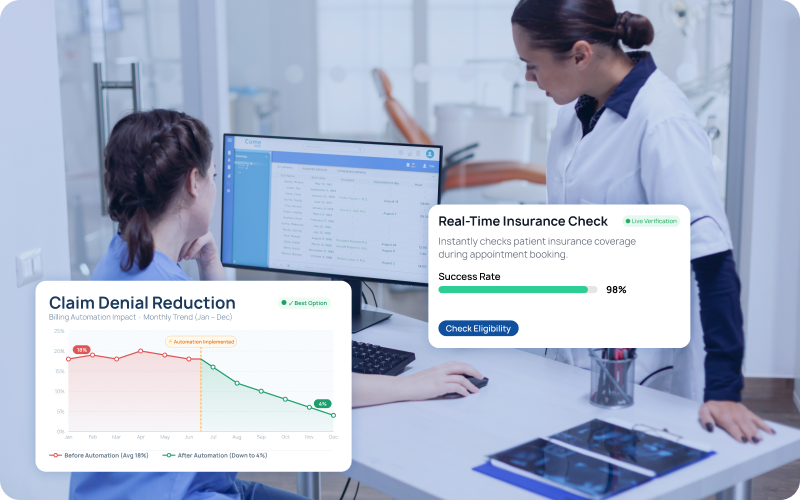
Insurance verified the moment an appointment is booked.

Automatically verifies insurance using insurance eligibility verification software with real-time eligibility verification in healthcare. No missed checks. No preventable claim failures. No surprise patient responsibility at check-in.

  • 270/271 EDI
  • Real-time verification
  • FHIR write-back
  • COB sequencing
  • Rechecks at every state change
  • Patient responsibility estimates pre-visit
Prior Authorization Automation — Da Vinci PAS FHIR, X12 278/279
70%
Faster turnaround
4x
Throughput per staff
02Prior Authorization

Approvals that don’t hold up your schedule.

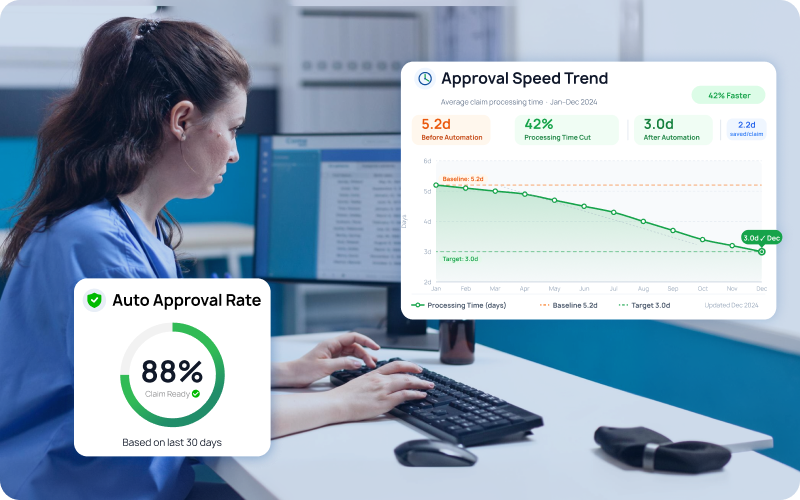
Streamline approvals with prior authorization automation software designed for automated prior authorization in healthcare. The system detects requirements instantly, pulls the right clinical data, and submits requests without manual back-and-forth — only involving your team when necessary.

  • Da Vinci PAS FHIR
  • X12 278/279
  • Gold card detection
  • Specialty templates
  • Auto-attached clinical evidence
  • Status polling & resubmission
Denial Management & Appeals — 835 ERA parsing, AI-generated appeals
35%
Fewer denials in 60 days
40+
Denial categories
03Denials & Appeals

Every denial analyzed, routed, and learned from.

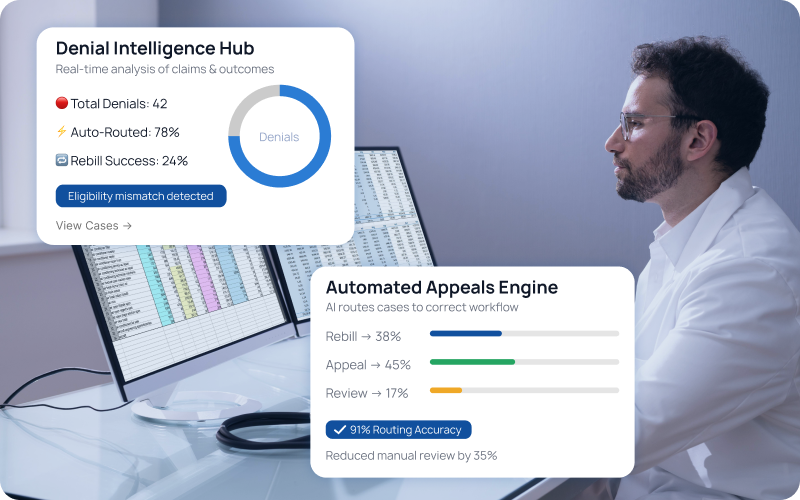
A complete denial management and appeals software that functions as a medical claims appeals management system for modern practices. It analyzes every denial, identifies root causes, and routes each case automatically — whether it’s a rebill, an appeal, or review — while learning payer patterns to prevent repeat issues.

  • 835 ERA parsing
  • 40+ categories
  • AI appeal letters
  • Payer pattern learning
  • Root cause dashboards (CO-45 / CO-97 / CO-252)
  • Auto-route: rebill, appeal, or review
In the first week alone, we caught over $30K in coverage gaps before visits. We didn’t realize how much revenue we were losing at the front desk.
MARIA J. — CFO, MULTI-SPECIALTY GROUP, CA

See it on your specialty’s billing rules in 30 minutes.

Book Free Demo

Live in 30 days · No EHR change required · HIPAA-compliant

Result

Real practices. Real revenue impact.

Three real-world results from practices that switched to ZeroDenial in the last twelve months — and the numbers that showed up on their next 90 days of statements.

Orthopedic Clinic · TX

We went from chasing denials every week to actually preventing them. Our denial rate dropped from 14% to 6% in under 60 days — and it’s stayed there.

Sarah R image
Sarah R.
Practice Manager · Orthopedic Clinic, TX
14% → 6% denial rate 60 days to results Held for 6+ months

Orthopedic clinic cuts denials more than half

The Challenge
  • 14% denial rate — biller drowning in rework
  • Repeat denials by code — nobody tracking the pattern
  • Cash flow erratic, write-offs climbing every quarter
The Result
  • Denial rate halved to 6% in under 60 days
  • Pattern learning prevents repeat denials by payer
  • Held the lower rate for 6+ consecutive months
14% → 6%
Denial Rate
60 days
To Result
6+ mo
Sustained
Cardiology Group · FL

Prior auth used to slow everything down. Now most cases are handled automatically, and my team only steps in when needed. Same staff — 4x the throughput.

Dr. David K. image
Dr. David K.
Medical Director · Cardiology Group, FL
4x PA throughput Same staff count 70% faster decisions

Cardiology group quadruples PA throughput

The Challenge
  • PA backlog delaying procedure scheduling
  • Staff manually pulling clinicals, faxing payers
  • Hiring more PA staff to keep up — cost spiking
The Result
  • Auto-detection, auto-submission, auto-status polling
  • Same staff handles 4x the case volume
  • Decisions land 70% faster on average
4x
Throughput
70%
Faster Decisions
0
New Hires
Multi-specialty Group · CA

We didn’t realize how much revenue we were losing at the front desk. In the first week alone, we caught over $30K in coverage gaps before visits.

Maria J. image
Maria J.
CFO · Multi-specialty Group, CA
$30K caught in week 1 Real-time coverage checks No EHR change

Multi-specialty group recovers $30K in week one

The Challenge
  • Front desk catching coverage gaps too late
  • Patient responsibility surprises at check-in
  • Self-pay write-offs that should’ve been billed
The Result
  • Eligibility verified the moment appointments are booked
  • $30K in coverage gaps caught in week one
  • Went live in 30 days — no EHR change
$30K
Week 1 Recovery
30 days
To Go Live
0
EHR Changes
Outcomes

The numbers that move the needle on cash flow.

What practices typically achieve in the first 60 days on ZeroDenial — published from real customer benchmarks across orthopedic, cardiology, and multi-specialty groups.

35%
Reduction in claim denials
Within the first 60 days, sustained for 6+ months
70%
Faster prior authorization
Auto-detect, auto-submit, auto-poll
95%+
Eligibility check accuracy
270/271 EDI with COB sequencing
30 days
From signature to live
No EHR change required

Stop losing revenue you’ve already earned.

Book a 30-minute demo. Let’s model your ROI for your specialty-specific clinical billing codes and rules.

Book Free Demo

Live in 30 days · No EHR change required · HIPAA-compliant

FAQs

Frequently asked questions.

Get answers to the most common questions asked to us by our esteemed clients.

The denial management process in healthcare involves identifying, analyzing, and resolving denied claims while preventing future errors. It includes root cause analysis, resubmission, and appeals. Modern denial management solutions for hospitals and clinics focus on fixing issues before submission, helping providers reduce rework and improve reimbursement rates across the revenue cycle.

The most common claim denials in medical billing include eligibility issues, missing prior authorization, coding errors, duplicate claims, and incomplete documentation. Understanding these patterns is essential for providers looking for tools to improve the clean claim rate in healthcare and reduce repetitive billing errors that impact revenue collection.

Healthcare providers can reduce claim denials by verifying eligibility in real time, automating prior authorization workflows, and identifying denial patterns early. Using strategies like automation and proactive validation helps prevent errors before submission and improves overall revenue cycle performance.

The first step in denial management is identifying the root cause of the denial through claim analysis and payer feedback. This determines whether a claim should be corrected, resubmitted, or appealed for faster reimbursement.

The denial management lifecycle includes claim submission, denial identification, root cause analysis, correction, resubmission or appeal, and prevention. An effective end-to-end approach ensures each stage is optimized to reduce repeat denials and improve clean claim rates.

CO-252 indicates that a service requires prior authorization but was not approved before submission. This can be prevented with automated prior authorization workflows that ensure approvals are secured before claims are submitted.

CO-97 means the billed service is included in another service already processed and paid. Proper coding and bundling practices can help avoid this issue.

CO-45 indicates that the billed amount exceeds the payer’s allowable charge. This is typically adjusted rather than appealed and requires accurate charge capture aligned with payer contracts.

Insurance eligibility verification prevents denials by confirming patient coverage, benefits, and financial responsibility before services are provided. Automating this process reduces errors related to inactive coverage and improves first-pass claim acceptance rates.

Prior authorization ensures payer approval before services are delivered. Missing or delayed approvals often lead to denials, while automation helps secure approvals faster and reduce claim rejections.

The average denial rate in healthcare billing ranges from 10% to 15%, depending on payer mix and workflow efficiency.

Automation improves denial management by identifying errors early, streamlining claim corrections, and reducing manual intervention, leading to faster reimbursements and improved efficiency.

Yes, AI can analyze denial patterns, classify codes, and generate appeal documentation automatically, reducing manual workload and improving recovery rates.

A strong denial management solution should include eligibility verification, prior authorization automation, denial tracking, root cause analysis, and appeals management, along with predictive insights to prevent denials before they occur.